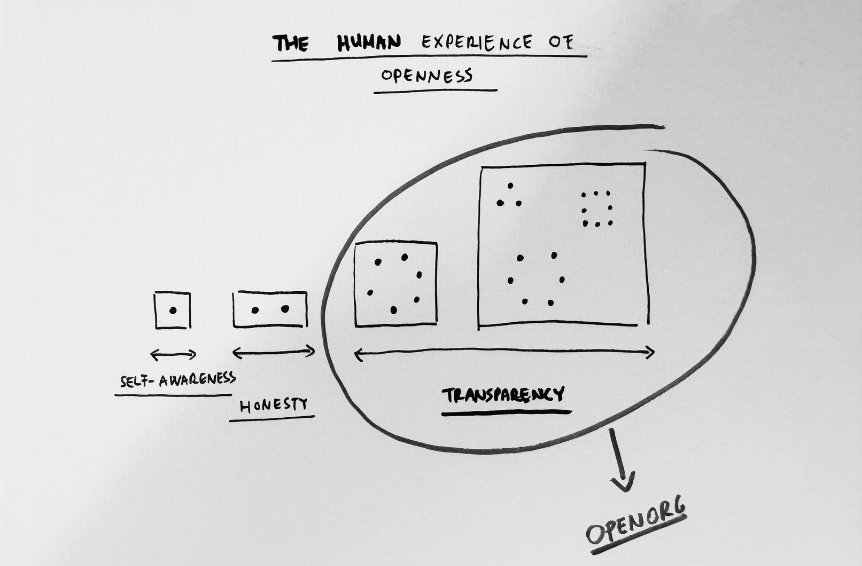
Transparency is something I have always cared deeply about – both from a personal and professional standpoint. And the two are actually closer than I thought.
Not because it is fashionable.
Not because it looks good in a culture deck.
But because it is profoundly human.
Recently, InPlanet became accredited by OpenOrg for 2025 and 2026 recognising its commitment to openness across hiring, compensation, career progression, flexibility and culture and more.
The due diligence process led by Adam Horn and the OpenOrg team was thoughtful and rigorous. It wasn’t about ticking boxes. It was about examining whether transparency is truly embedded in the system whether it is lived, not just documented.
We are proud of the accreditation.
But what matters to me most is the principle behind it.
And here is where I want to provoke, intentionally.
Sometimes in business we are hesitant to draw parallels with personal life. We treat organisational questions as technical problems – structures, incentives, processes. We avoid bringing in human experience because it feels too soft, too emotional, too philosophical.
But organisations are human systems.
And if we are willing to look honestly at the human experience, we often find simple truths that apply at scale.
Individual – Self-Awareness
At the most personal level, transparency begins internally.
We call it self-awareness. Honesty with ourselves.
Psychologist Carl Rogers spoke about congruence, the alignment between our internal world and external behaviour. Without that alignment, we fragment. We perform versions of ourselves. We protect rather than grow.
Self-transparency is not comfortable.
But it is liberating.
It is the foundation of maturity.
Duo (1:1) – Honesty and Safety
Move one layer outward.
In close relationships – romantic partnerships or deep friendships – transparency becomes honesty between two people. Most relationship research consistently points to honesty as the cornerstone of trust and psychological safety.
Without honesty, doubt fills the gaps.
With honesty, even difficult conversations deepen connection.
Transparency creates safety.
Safety enables growth.
Team – Where Transparency Becomes Performance
Now we move to teams.
A team is where individual psychology meets collective performance.
Think about the classrooms, project groups or early teams that shaped you. Yes, the teacher or leader mattered but what truly defined the experience was the team dynamic. The atmosphere. The permission to speak. The clarity around expectations.
In that setting, the teacher is essentially a team leader. Their role is not just to instruct, but to create a space where transparency is normal:
Clear feedback.
Honest conversations about strengths and weaknesses.
Open acknowledgment of potential.
Addressing tensions early rather than letting them fester.
In high-functioning teams, transparency shows up as:
-
Clear roles
-
Visible decision-making logic
-
Shared standards of performance
-
The ability to admit mistakes
As organisational psychologist Amy Edmondson demonstrates in her work on psychological safety, teams perform best when people feel safe to speak up and take interpersonal risks.
Transparency is the precondition for that safety.
And safety is the precondition for performance.
Organisation – Transparency at Scale
An organisation is simply a network of teams.
As complexity increases, the psychological principle does not change – it just becomes structural.
At organisational level, transparency becomes embedded in systems:
Clear hiring expectations.
Transparent compensation philosophy.
Defined career paths.
Open communication about strategy and trade-offs.
When systems are opaque, people spend energy decoding politics.
When systems are transparent, people spend energy creating value.
Transparency reduces uncertainty.
Reduced uncertainty builds trust.
Trust strengthens retention and long-term performance.
Why This Matters
Sometimes when we step back from frameworks and policies and look at human psychology, business becomes simpler.
At the individual level, we need self-awareness.
In a duo, we need honesty.
In teams, we need psychological safety.
In organisations, we need structural transparency.
The scale changes.
The principle does not.
If I am honest, this is why our OpenOrg accreditation means something to me beyond recognition. The process challenged us to look deeply at whether openness is truly part of our DNA, not selectively, but consistently.
Transparency is not about radical exposure.
It is about clarity.
It is about coherence.
It is about fairness.
And at a very human level, people want to feel seen. They want their contribution to be recognised. They want to understand where they stand. They want to feel that the system around them is honest.
Those experiences are only possible in environments where truth is safe.
Transparency at work is simply transparency at scale.
And when we allow ourselves to look at business through the lens of human experience, we often find that the answers were there all along.